
France’s new Socialist President François Holland faces forces that could well undermine his manifesto pledges of growth and rollback before he even gets started.
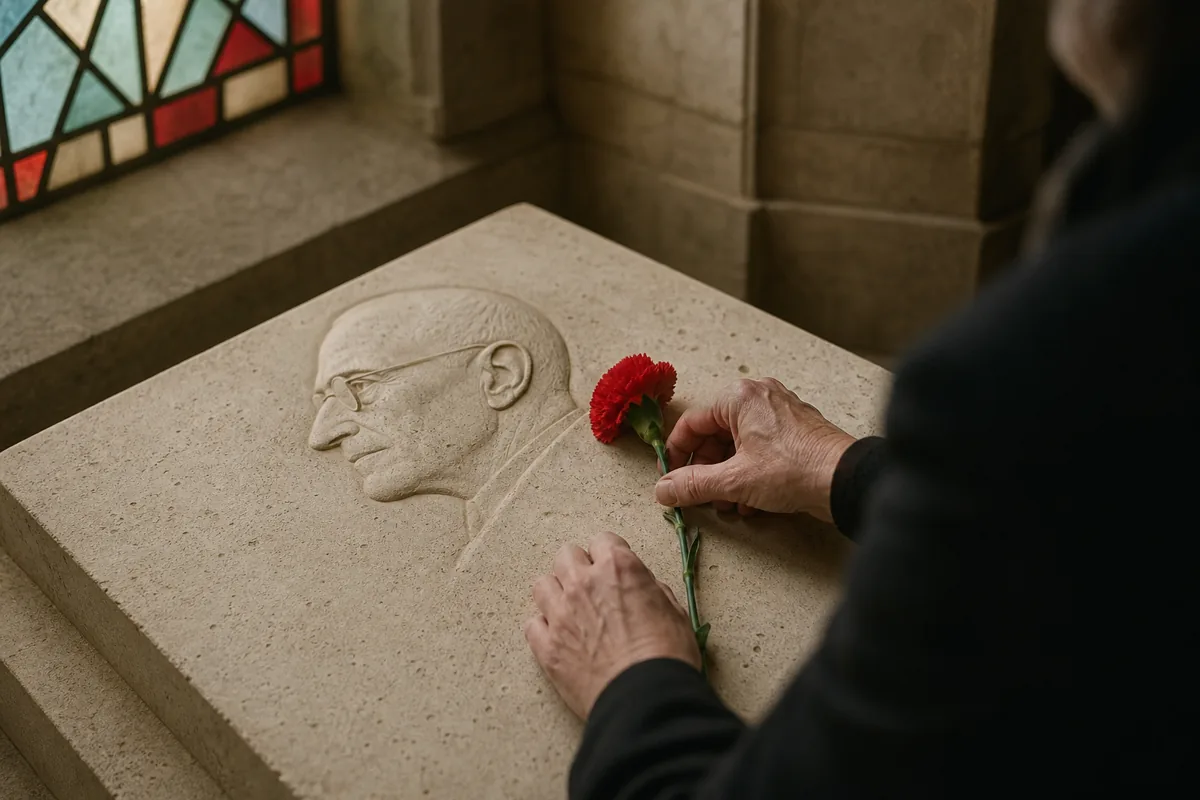
Turning in his grave? Robert Schuman is buried in Saint Quentin church, in Scy-Chazelles, near Metz, France (Photo credit: Wikipedia)
In the article below Martin Feldstein, Professor of Economics at Harvard University and President Emeritus of the National Bureau of Economic Research (extract reprinted with permission) reminds us that it was a previous Socialist president François Mitterrand who wrung approval from Germany for the euro and its underlying European political unification agenda, by making it a condition of French support for the reunification of Germany that occurred on October 3 1990.
.
Cambridge, MA, USA – The crisis in the eurozone is the result of France’s persistent pursuit of the “European project,” the goal of political unification that began after World War II when two leading French politicians, Jean Monnet and Robert Schuman, proposed the creation of a United States of Europe.
Monnet and Schuman argued that a political union similar to America’s would prevent the types of conflict that had caused three major European wars – an appealing idea, but one that overlooked America’s horrific Civil War. A European political union could also make Europe a power comparable to the United States, and thereby give France, with its sophisticated foreign service, an important role in European and world affairs.
The Monnet-Schuman dream led to the 1956 Treaty of Rome, which established a small free-trade area that was later expanded to form the European Economic Community. Establishing the EEC had favorable economic effects, but, like the North American Free Trade Area, it did not reduce national identification or create a sense of political unity.
(Extract reprinted with permission. To read the full article follow this hyperlink)
Meanwhile others are expressing increasing concern about the EU project in itself, from its genesis through various phases of its development to what some see as today’s eminently un-democratic organisation, seemingly using the currency crisis to trample on democratic rights in some sovereign nation states.
Some commentators worry whether, despite the outcome of two World Wars, Germany thanks to the EU, has now found a way of imposing its will. Others however suggest that historically it was France in the Napoleonic era, that tramped and trampled regularly across the borders of what is today Germany and that now by wielding its Big Austerity Stick, post- Bismarckian Germany is extracting a long-awaited revenge.
Conservative writer Bruce Anderson in the London-published Daily Telegraph – At the heart of Europe’s crisis is the abolition of the nation state and the attempt to impose monetary union – suggests that a costly and painful return to national currencies is the only way out of the current crisis.
While leftwing commentator Brendan O’Neill writing in Spiked says: “…It is of course true that Brussels put enormous pressure on democratically elected leaders in Italy and Greece to replace themselves with technocrats. But it is wrong to view the EU as the creation and fiefdom of small numbers of ruthless leaders. In truth, the EU project of the past 40 years arose from the needs of all of Europe’s cut-off, legitimacy-lacking national elites. Feeling themselves increasingly estranged from their own populaces, and more crucially from the political legitimacy that comes with having a connection with the populace, national elites chose to club together in Brussels, to create new institutions which would allow them both to formulate political and economic policy away from the madding crowd and also to derive some measure of political legitimacy from the idea that they were pursuing ‘the European project’ rather than from their own demos.
“Fundamentally, the EU represents, not German expansionism or French arrogance, but the collective and cowardly pooling together and dilution of national sovereignty by the leaders of modern Europe. This was not real European unity, a democratic bringing-together of the European peoples, but rather a safety net for the European elites. Where the exercise of national sovereignty demands that the political class have meaningful roots and relationships in society, the post-sovereign, pseudo-cosmopolitan institutions of the EU allow it to pursue politics and economics in an entirely insulated fashion. In this sense, the technocracy created in Italy and the usurping of normal democratic politics in Greece and Ireland are not deviations from the EU project; they’re the logical conclusion to it. We are seeing in brute form what the EU has always been about: the elites’ flight from the political realm into the comfort zone of bureaucracy.”
Much more on the ongoing disorderly, disjointed and disastrous euro-crisis is to be found in this blog by the London Telegraph’s Ambrose Evans-Pritchard: Papademos, Grexit, and catastrophe blackmail , while a point of view that should certainly worry the reader, is set out in detail here: is Europe on the brink of war?
A step by step timeline of how we got to where we are today has been succinctly set out here by Business Insider
Related articles
- Foreign Affairs Report: The Future of the Eurozone (foreignaffairs.com)
- Let’s have a prize for guessing what EU leaders actually mean (independent.ie)
- The Eurozone Crisis For Dummies (businessinsider.com)
- Letters: Europe’s democratic deficit (guardian.co.uk)
- Who Lost the Euro? (businessweek.com)
- Is Europe really at the brink of war? (p2pfoundation.net)
